
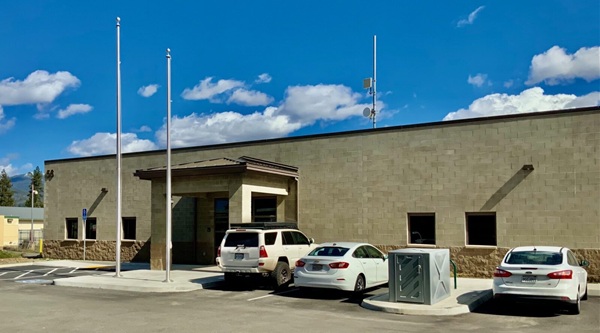
Inmate data management is about to get a lot easier and more efficient for the staff at the Plumas County Sheriff’s Correctional Facility, where a new radio-frequency identification system is expected to be online by the end of March.
According to Jail Commander Steve Clark, the RFID system will streamline the collection and storage of data on inmates’ locations and movements and will also document the security and safety checks conducted by staff. Clark said this will lead to a potential 25% or greater reduction in the staff time currently committed to these tasks by eliminating the need for radio calls, paper records and data entry.
“Let’s say an inmate’s in a safety cell,” said Clark, referring to a cell where inmates are placed when intoxicated, agitated, suicidal or otherwise needing frequent observation. “We have to do a random check at least every 15 minutes,” he said, to document the inmate’s condition and activity. Currently, observations are logged by checking boxes on a paper form, then manually entered into the jail’s computer system. With the new system, Clark said, data is logged electronically and is available immediately to all staff involved with the inmate.
The system also supports greater staff accountability through its documentation of their actions. It can improve the consistency of inmate monitoring by notifying staff when a scheduled inmate check is required. It issues alerts when inmate checks are not being done at random times or within the required timeframes. Any lapses can be identified by viewing data from each shift without having to go hour-by-hour through paper records.
“It will make it easier,” especially across shift changes, said Stephanie Tanaka, Plumas County alternative sentencing program manager. “It makes the communication and the logging for that individual much more concise,” she added.
The RFID system also includes substance abuse data and other behavioral health records as well as medical information, Tanaka said. It can track inmates’ medication schedules, helping staff ensure that the correct medications are administered on time to the correct inmates. In a small jail, said Clark, the staff would typically know these things, but the additional controls will add another layer of protection for inmates and staff.
The jail facility has been accredited by the National Commission on Correctional Health Care since 2021. According to Clark, during a recent accreditation visit, NCCHC recommended that the jail move from paper to electronic medical records in response to a state mandate. The new system will help smooth that transition, said Clark.
More convenient access to inmate data is also helpful when the facility prepares for its regular inspections from the California Bureau of State and Community Corrections. BSCC typically asks for data covering a specific period of weeks or months, and the system can produce the needed reports quickly and easily.
According to Wired Magazine, since about 2023, correctional facilities have increasingly used inmate tracking systems to offset staffing shortages. That was not the primary motivation here, said Clark, but “it’s going to save time.”
When the new jail facility opened in June 2024, it was staffed with 14 officers. “We’re up to 20 right now. We’re three away from being topped out, so our staffing levels are doing really well,” said Clark. However, he expects the new system will free up one full-time staff member immediately. “Right now, to do our inmate safety checks, we’re radioing the control room” to document the checks, said Clark. This interrupts workflow for the control room officer. “It’s almost like we need two people in the control room,” with one handling the documentation calls, he said.
Cost and funding
The system will cost $60,000 during its first three years of implementation, Clark said. That includes $14,000 per year for monitoring and cloud data storage, as well as the cost of equipment, supplies and staff training.
The RFID system was developed by Guardian RFID, considered one of the most advanced providers of inmate tracking systems, according to Justice Design News. “I’ve wanted to get Guardian for years,” said Clark, who credits Tanaka with identifying the necessary funding source.
Through her work overseeing alternative sentencing, Tanaka handles Medi-Cal reimbursement funding for Plumas County’s correctional programs. She suggested this as a potential source of funds to support the RFID system because its functions include maintaining inmate medical records and documenting the time medical staff spend interacting with inmates. Tanaka anticipates that Medi-Cal reimbursement will fully fund the system.
How it works
The Guardian system uses passive RFID chips in wristbands worn by inmates, and interacts with wall-mounted RFID tags throughout the facility. Inmate data is collected through four Spartan 3 mobile devices, which resemble an Android smartphone in appearance and function. The devices allow data input to a range of categories, including inmate profiles, observations, movements, supplies, meals, recreation, headcount and special statuses like medical conditions and dietary restrictions.
When an officer scans the RFID tag on the wall outside of a classroom, residence unit, counseling office, the medical clinic or any other secure space, the device displays a list of the inmates currently in that space, along with their photos. Officers can scan inmates’ wristbands and select new locations for inmates as they are moved within the facility. The device can take additional photos to be linked with inmate data, which is automatically synced with the jail’s computer system and is stored for seven years by Guardian’s cloud service.

Inmates will be required to wear their wristbands and not tamper with them. Although durable, wristbands could potentially be removed by inmates but would be damaged in the process. Inmates who remove their wristbands will be charged a fee for replacement, and could also face a criminal charge of destroying jail property under California Penal Code Section 4600. Additionally, Title 15, Section 3011 of the California Code of Regulations allows for administrative disciplinary action such as loss of inmate privileges or credits in such cases.
RFID technology was developed about 50 years ago to track retail inventory. It supports library book detection systems and retail anti-theft systems. It was first used in a correctional setting at California State Prison, Corcoran in 1997, to increase staff accountability in response to a scandal in which prison staff were eventually charged with federal civil rights violations for organizing exhibition fights among inmates.
According to a 2009 report, the technology was first used for inmate tracking at a Michigan juvenile detention facility in 2002. Guardian RFID reports that its systems are used widely in California correctional facilities.
Looking to the future
The new RFID system is currently set up and ready to use at the jail. Clark provided a demonstration of its operation for The Plumas Sun, but photography was not permitted within the jail facility. On March 24 and 25, a consultant from Guardian RFID will train staff at the jail and then observe and assist the staff in using the system for an additional day to ensure that all shifts are proficient with it, said Clark.
While he sees this new system as an important initial step in improving inmate monitoring and data management, Clark has his sights set on more detailed monitoring of inmate health and activity. He hopes the jail can eventually work with Plumas County Public Health to acquire battery-powered RF transmitters that track heart rate, blood pressure, oxygen saturation and activity level. The jail houses an increasing number of medically fragile inmates. If real-time biometric monitoring could be implemented at some future point, it would offer substantial benefits, he said.
Source: Plumas Sun