
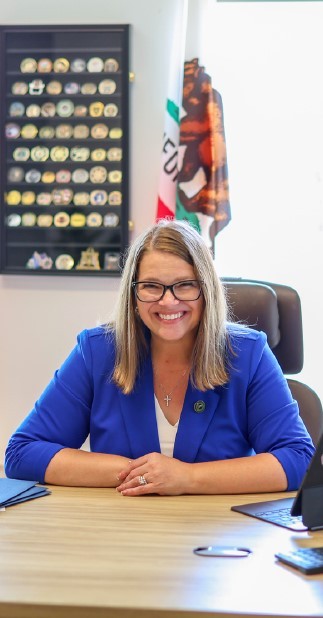
Assemblywoman Heather Hadwick (R-Alturas) is highlighting more than $120 million in funding priorities she advocated for through California’s 2026 budget process, along with a critical policy extension protecting California’s goat and sheep herding industry.
Among Hadwick’s most significant budget efforts was leading the charge on the Assembly side to extend the sunset on California’s exemption affecting goat and sheep herders—an issue that threatened major consequences for livestock operations, targeted grazing and wildfire fuel reduction efforts across the state.
The final agreement extends the exemption through 2029, providing three additional years for lawmakers, agricultural organizations and other stakeholders to develop a permanent legislative solution.
“This was a huge issue for an industry that most Californians probably never think about—but the consequences of getting it wrong would have been enormous,” Hadwick said. “Our goat and sheep herders are an important part of California agriculture, and their animals are increasingly being used to reduce vegetation and wildfire fuels. We could not afford to cripple this industry with a policy that simply did not work on the ground.”
Hadwick said the extension is not the end of the issue but provides critical time to work toward a long-term solution.
“We bought ourselves three years, and now we need to use them,” Hadwick said. “I want everyone at the table so we can develop a permanent solution that protects workers while recognizing the realities of agriculture and an industry that does not operate on a traditional eight-hour workday.”
A Personal Win for Whiskeytown Environmental School
One of the smallest appropriations Hadwick advocated for carries some of the greatest personal significance: $1 million for the Whiskeytown Environmental School Community to support housing and science programs as the camp continues rebuilding following the devastating 2018 Carr Fire.
Last year, she had the opportunity to meet the camp’s directors at a Leadership Redding fundraiser benefiting the effort to rebuild the beloved North State program.
“Whiskeytown is personal for me,” Hadwick said. “I attended this camp as a kid through Big Brothers Big Sisters, and some of my very best childhood memories were made there. I know what places like this can mean to a child because I was one of those kids. Getting to meet the directors last year and hear about the work they are doing to rebuild after the Carr Fire made me even more determined to help.”
The funding will support the ongoing effort to rebuild infrastructure and cabins and restore the weeklong outdoor science camp experience that served generations of North State students before the Carr Fire.
“To see $1 million included to help bring this incredible place back for another generation of kids is one of those moments that brings everything full circle,” Hadwick said. “I cannot wait for children to once again have the opportunity to make the same kind of memories there that I did.”
More Than $120 Million in Priorities and investments:
Hadwick also led and collaborated with other legislators to secure investments included in the state budget. From smallest to largest, those priorities include:
- $600,000 — Placer County to remove steel and concrete wreckage from the McKeon Ponderosa/Sliger Mine Road Bridge from the American River, which collapsed in 1964 following the failure of the Hell Hole Dam;
- $1 million — Whiskeytown Environmental School Community for housing and science programs and its ongoing rebuilding effort;
- $3.4 million — California Tahoe Conservancy;
- $4 million — California cultural districts;
- $4 million — California fairs;
- $4.6 million — projects improving land access and tenure for socially disadvantaged farmers and ranchers, tribal producers, and beginning farmers and ranchers;
- $5 million — Upper Truckee Marsh South Project;
- $5 million — wolf conflict management, including $2.5 million for wolf-livestock compensation and $2.5 million for wolf management and rapid response during significant livestock depredation events;
- $10 million — Victims of Crime Act (VOCA) funding for organizations providing services to survivors of child sexual assault;
- $10 million — FARMER program to help offset the cost of replacing agricultural equipment and vehicles;
- $35.5 million — Forest Health Program and Tribal Wildfire Resilience Program; and
- $40 million — SAFER program to help provide safe and affordable drinking water to Californians who currently lack access.
“These numbers represent much more than lines in a state budget,” Hadwick said. “They mean helping a rancher dealing with wolves, replacing aging farm equipment, reducing wildfire risk, keeping our fairs alive, protecting our forests, providing safe drinking water and rebuilding a camp where generations of North State kids have made memories.”
Hadwick said many of the priorities are particularly important to Assembly District 1 and rural communities that can easily be overlooked during negotiations over California’s massive state budget.
“The state budget is hundreds of billions of dollars, and rural California can get lost in that conversation pretty quickly,” Hadwick said. “My job is to make sure it doesn’t—to keep showing up, explaining why these programs matter and fighting to make sure our communities have a seat at the table.”
For Hadwick, the budget victories also illustrate that legislative accomplishments are not limited to bills carrying a lawmaker’s name.
“Not every win in Sacramento comes with your name on a bill,” Hadwick said. “Sometimes it is a line in a thousand-page budget that keeps a program alive, helps a rancher stay in business, removes dangerous debris from a river, protects a community from wildfire or gives a kid the chance to experience a place like Whiskeytown. Those wins matter, too.”
With the legislative session concluded, Hadwick said work will continue implementing the funded priorities and developing a long-term legislative solution for California’s goat and sheep herders.
“Rural California deserves a seat at the table,” Hadwick said. “My job is to make sure we have one.”