
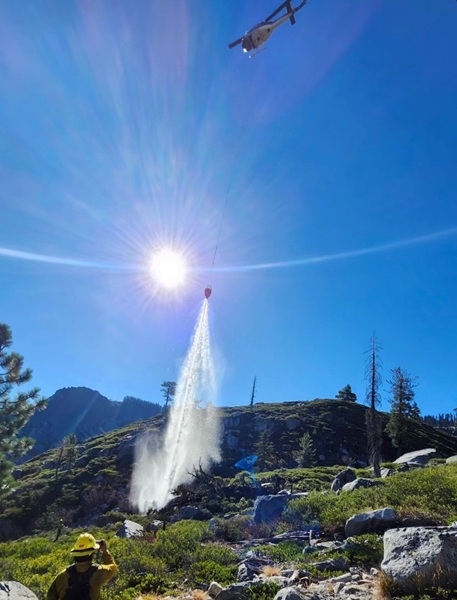
Thunderstorms yesterday over the Plumas National Forest brought lightning over dry fuels with light precipitation and resulted in four confirmed lightning fires.
Three of the fires are in the Bucks Lake area and one is located near Oro-Quincy Highway and French Creek Road. None of the fires grew to a quarter acre. All of the fires are contained.
Fire danger on the Forest remains high, especially following a return to summerlike hot temperatures last week. There has not been a fire season ending weather event, despite some cooler temperatures and storms in early September. As a result, forest fuels remain extremely dry and conditions are more like August than October.
There is currently a Heat Advisory in effect through 10 p.m. Friday over parts of the Plumas National Forest, including the Feather River Canyon and Middle Fork Feather River. Per the Advisory, high temperatures are expected to be between 94 to 102 degrees with overnight low temperatures in the mid-60s to low-70s.
A dry cold front is predicted in the area this weekend, which will bring cooler temperatures and possible winds. Next week’s forecast indicates a return to unseasonably warm, dry weather, with no rain in the extended forecast.
This is also the time of year when north wind events can bring strong, gusty winds. Some of the largest and most destructive fires on the Plumas National Forest have happened in the fall.
“When we receive lightning in the late spring and early summer, there is usually rain and fuels conditions aren’t as receptive to carry fire quickly,” said Plumas National Forest Fire Chief Martin Senter. “In late summer and fall, lightning on dry fuels can quickly become a large wildfire, threatening communities and infrastructure.”
Firefighters are continuing to monitor conditions, reconning and will respond to lightning fires as they are discovered in coming days.
Holdover lightning fires can smolder for days and even weeks following a thunderstorm. After a wet thunderstorm, it can take several days of dry and warm weather for fires to become visible.
“Public and firefighter safety is our highest priority,” Senter said. “With the current conditions, we are responding and suppressing fires as they are discovered and applying strategies to control fires as safely and efficiently as possible.”
With the current fire danger and fuels conditions, the Plumas National Forest remains under Stage I Fire Restrictions. Campfires are only allowed in designated recreation sites identified in Exhibit A of the restrictions.
If you choose to have a campfire at one of these locations, never leave it unattended and make sure it is completely out and cold to the touch. Make sure that the area is cleared of flammable materials and have a shovel and plenty of water ready. Wind can carry a spark or ember and start a larger fire.
To reduce the risk of wildfire, area residents and visitors are advised to do the following:
- Consider alternatives to a campfire, such as a portable camp stove.
- If you are using charcoal, make sure you drown and stir them, repeating until they are cold to the touch.
- Avoid driving and parking in tall grass or on roads with heavy, fine fuel accumulations. Exhaust particles, hot exhaust pipes and hot catalytic converters can start grass fires in a matter of seconds.
- Maintain proper tire pressure. Ensure tires are in good condition with solid tread and no cracking in the walls. Driving on exposed wheel rims can throw sparks.
- Secure chains properly from trailers or other equipment. Sparks from dragging chains, and exhaust from ATVs and motorcycles, can start grass fires.
- Ensure spark arresters are clean and in working order. Spark arresters are required on all recreational and portable gasoline-powered equipment.
- Carry firefighting equipment in vehicles, including a shovel, at least one gallon of water or one 2 ½ pound or larger fire extinguisher.
Report suspected wildfires immediately by calling 911, even before starting suppression activities. Similarly, report accidents and emergency incidents by immediately calling 911. Many cellphones, even in areas without service, still have 911 or emergency capabilities to call for help.
“We are still in active fire season on the Plumas National Forest,” Senter said. “We appreciate the continued vigilance and help from the public to prevent wildfires.”
For more information on the Plumas National Forest, visit www.fs.usda.gov/plumas or on Facebook at www.facebook.com/USFSPlumas.