
The California Department of Fish and Wildlife posted several updates on gray wolf activity in August.
They released the quarterly wolf news update, a new activity map, and an updated list of known wolves in the state. The agency also shared a wolf-livestock depredation report that summarizes conflicts between wolves and livestock. This report updates regularly to track changes.
The department changed its wolf identification system starting July 1. The old method assigned wolves unique identifiers based on the pack where a wolf was born or confirmed as a breeder. The new system gives each wolf a unique ID in the order the agency identifies them, regardless of pack affiliation. This change aims to make wolf identification easier for the public.
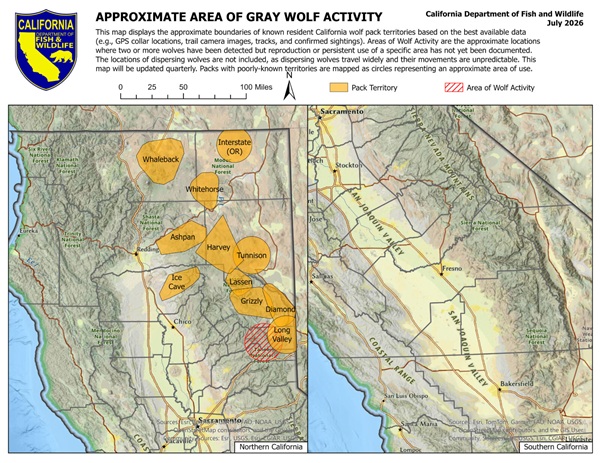
The new gray wolf activity map shows known wolf locations as of July 2026. The agency asks the public to report wolf sightings on its Gray Wolf Sightings Report page. Since December 2011, biologists have found dispersing wolves in California. The agency uses reports, DNA tests, camera traps, and track surveys to monitor wolves in Sierra, Nevada, Butte, Kern, Modoc, Plumas, and Shasta counties.
Several wolf packs in Plumas County remain active. The Diamond Pack in eastern Plumas and southern Lassen counties shows no sign of pups this year and no livestock attacks during the reporting period. The Grizzly Pack in southern Plumas County also has no pups but recorded one probable depredation. The Ice Cave Pack covers western Lassen, northern Plumas, eastern Shasta, and northern Tehama counties with no pups or livestock conflicts.
The Lassen Pack in northern Plumas and southern Lassen counties confirmed reproduction this year with at least two pups. Genetic analysis detected a previously unknown wolf from the 2025 litter. The Long Valley Pack in eastern Sierra, eastern Plumas, and southern Lassen counties shows no pups or depredations.
The agency continues to monitor these packs with camera traps and ground surveys. No active tracking collars are currently in place on any of the packs, though some wolves have nonfunctioning collars.
You can help by reporting wolf sightings to the California Department of Fish and Wildlife. Your observations assist biologists in tracking wolf movements and understanding their impact on local ecosystems and livestock. Would you know how to identify a wolf in the wild? Your reports could shape future conservation efforts.