
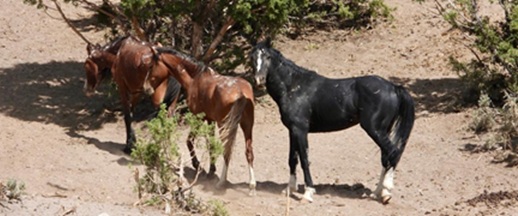
The Elko and Ely Districts concluded the 2026 Antelope and Triple B Complexes (complexes) wild horse bait and water gather on June 13, 2026. The BLM gathered and removed 700 excess horses from Antelope and 301 excess horses from Triple B Complexes on public land
The purpose of the gather is to prevent undue or unnecessary degradation of the public lands associated with excess wild horses and to restore a thriving natural ecological balance and multiple-use relationship on public lands, consistent with the provisions of Section 1333(b) of the 1971 Wild Free-Roaming Horses and Burros Act. Removing excess animals would also enable significant progress toward achieving the Standards for Rangeland Health identified by the Northeastern Great Basin Resource Advisory Council.
Details of Gather:
The BLM will utilize bait and water traps to gather and remove up to 1,000 (approximately 700 from Antelope and 300 from Triple B) excess wild horses. During the gather, the BLM will collect information on herd characteristics and determine herd health.
Public Observation:
Due to the nature of the bait and water trap method, wild horses and burros are reluctant to approach the trap site when there is too much activity; therefore, only essential gather operations personnel will be allowed at the trap site during gather operations.
Adoption Information:
For information on how to adopt a wild horse, visit www.blm.gov/whb.
Background:
The Antelope/Antelope Valley Complex is located in northeastern Nevada. The nearest town is Ely, Nevada, approximately 50 miles southwest. The Complex encompasses several herd management areas where wild horses live. The topography is varied and contrasting with valley floors, alluvial fans, canyons, mountains, steep ridges, and basins. Elevations range from 5,700 feet up to 10,000 feet. The climate is semi-arid with approximately 16 inches of precipitation per year at higher elevations, and approximately 8 inches at lower elevations. Due to the variance of topography, wild horses can be seen at different elevations throughout the year, but normally follow a pattern based on climatic and seasonal conditions.
The Triple B HMA is located about 30 miles northwest of Ely, Nevada, in White Pine County. This HMA is typical of the Great Basin region, characterized by north-south trending mountain ranges. Significant features are large flat valley bottoms and steep mountains with elevations ranging from about 6,000 feet on the valley floors to 9,000-plus feet atop the mountain peaks. The area is remote and rugged. Vegetation in the HMA consists primarily of brush, fir and mountain mahogany in the higher elevations, pinion-juniper and sagebrush on the lower mountain slopes and white sage, black sage, saltbush and other “salt desert shrub” type communities on the valley floors.