
QUINCY — In a striking display of interagency unity, a row of uniformed fire officials filled the Plumas County Board of Supervisors boardroom on Tuesday, Oct. 13, coming together to support a major boost in local public safety.
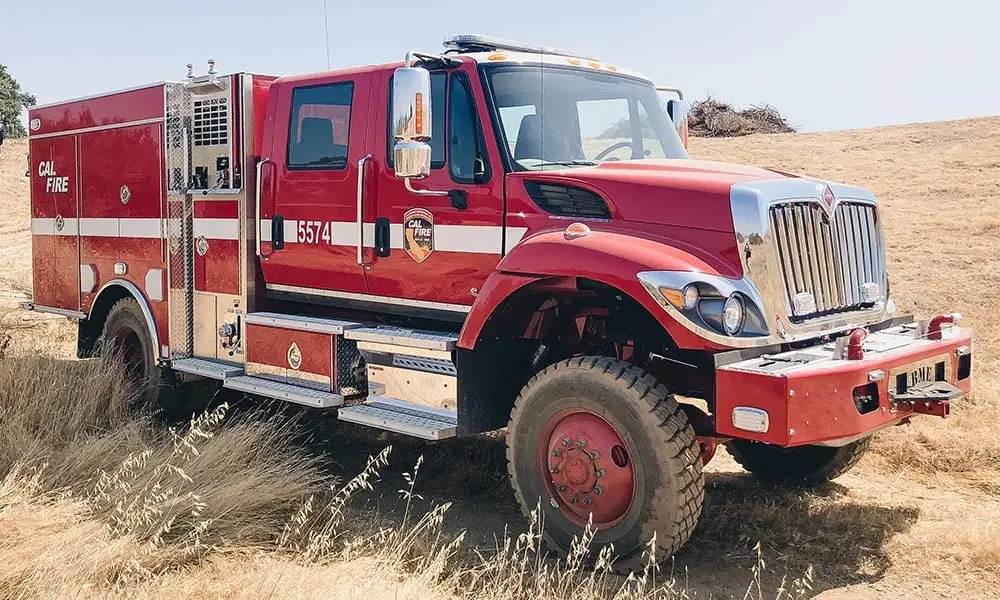
The gathering marked the official announcement that the California Department of Forestry and Fire Protection (Cal Fire) will move a specialized fire engine to Quincy starting this December—marking the first time a state agency engine will be stationed in Plumas County.
Josh Kern, chief of Cal Fire’s Lassen-Modoc Unit, described stationing the Type 3 engine—a rugged, off-road vehicle designed to navigate steep and challenging terrain—as a “meaningful investment” in public safety. Kern noted that the move represents an initial step in a broader long-term strategy to expand Cal Fire’s footprint across the county, with the goal of eventually redirecting additional personnel to Quincy.
“We had to do this to get a foot in the door in Quincy,” Kern said.
A Unified Front
Local fire leadership enthusiastically welcomed the extra resources. Frank Carey, chief of the Quincy Volunteer Fire Department, praised the arrival of the additional equipment.
“It does not matter what patch we have on our sleeves. We’re all part of one team,” Carey said, emphasizing the collaborative spirit among departments.
Board Chair Mimi Hall commended the strong agency partnership, calling the relocation “a strategic move” for the county. “There’s no territorialism. We want to see more of that in the world,” Hall added.
Shifting Resources Across the Region
To bring the Type 3 engine to Quincy, Cal Fire will redirect it from Westwood, where the agency operates a station at Third and Greenwood streets.
That shift drew questions from Supervisor Tom McGowan, who raised concerns about how moving the equipment might impact the Almanor region and the nearby Chester area, which he represents. “You are essentially reducing the response to the Chester area,” McGowan noted, inquiring whether Cal Fire had plans for a dedicated station in Chester. Kern responded that there are “nothing yet” regarding a station in Chester.
To maintain robust coverage during peak risk periods, Kern explained that Cal Fire will relocate an engine from Susanville to Westwood to cover the Chester area and will “staff up” its regional presence whenever fire danger climbs.
Regional Cooperation and Future Growth
For years, fire protection responsibilities in Plumas County—where more than 70% of the land is federally managed by the U.S. Forest Service—have been governed by a land-swap arrangement between Cal Fire and federal authorities. Under this agreement, Cal Fire traded some local protection responsibilities to the Forest Service in exchange for covering federal land elsewhere in California to prevent overlapping resources.
Marty Senter, fire management officer for the Plumas National Forest, underscored that close daily cooperation remains the priority. “It’s not about the color of the engines but the safety of the public,” Senter said.
County leaders expressed optimism about Cal Fire establishing a permanent, long-term foothold in Plumas County.
Supervisor Jeff Engel remarked that he was glad to see tangible action, noting that “there’s been a lot of talk but no teeth in it.” Meanwhile, Supervisor Kevin Goss pointed out that a permanent station has long been discussed and lobbied for locating future infrastructure in Indian Valley, citing its central geography.