
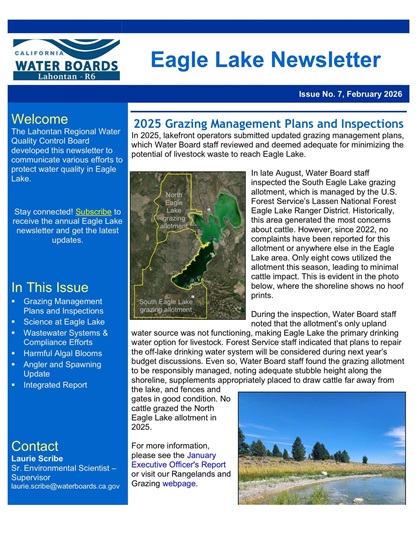
Water quality, grazing management and trout populations are all showing positive signs at Eagle Lake, according to the latest newsletter from the Lahontan Regional Water Quality Control Board.
Grazing inspections show minimal impact
In 2025, lakefront operators submitted updated grazing management plans aimed at reducing the risk of livestock waste reaching the lake. Water Board staff reviewed the plans and found them adequate.
An inspection of the South Eagle Lake grazing allotment — managed by the U.S. Forest Service’s Lassen National Forest Eagle Lake Ranger District — found limited cattle use this season. Only eight cows grazed the allotment, and no complaints have been reported in the Eagle Lake area since 2022. Inspectors reported minimal shoreline impact, proper fence maintenance and appropriate placement of supplements to keep cattle away from the lake.
No cattle grazed the North Eagle Lake allotment in 2025.
Fishing success improves, young trout on the rise
An angler update from the California Department of Fish and Wildlife shows that while catch rates dropped in 2024 compared to the previous year, early 2025 data points to improved success for anglers, with more fish being caught per hour.
Biologists noted a high number of recently stocked, younger trout in the lake. As a result, the average fish size dipped slightly to about 17.3 inches and 2.34 pounds. However, fish remain in healthy condition, and growth rates for stocked trout are holding steady at roughly 1.5 to 2 pounds per year.
During spring spawning efforts, crews captured and released 1,690 adult trout, spawning 322 pairs and producing about 1.05 million fertilized eggs. In 2025, approximately 160,000 trout were released into the lake. The fish ladder on Pine Creek was also opened to allow natural upstream spawning.
Research project studies lake health
Researchers from the University of Nevada, Reno are continuing a multi-year study of Eagle Lake’s fishery, food web and water quality in partnership with state wildlife officials and Trout Unlimited.
The research includes quarterly fish population surveys, water quality monitoring and tracking of tagged Eagle Lake rainbow trout. About 400 adult trout were tagged last year, with more tagging planned.
Scientists are also studying plankton and insects that form the base of the lake’s food web, along with conditions in Pine Creek, the lake’s largest inflow. The goal is to better understand how changing water levels and environmental conditions affect the lake’s native fish and overall ecosystem.
Eagle Lake, the second-largest natural lake entirely within California, is known for its unique, native fish community — including the Eagle Lake rainbow trout — and remains a priority for water quality protection and long-term conservation efforts.