
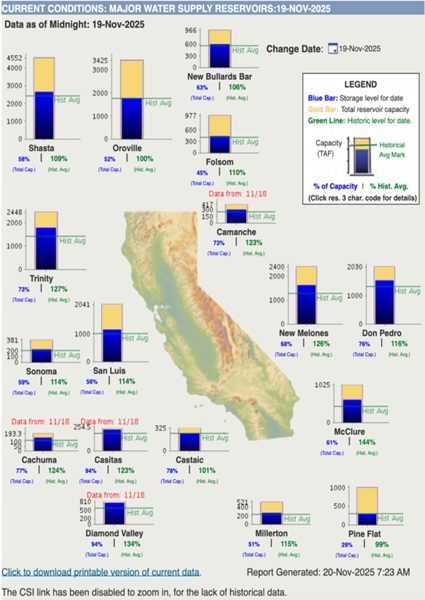
California’s water reservoirs are showing strong early-season gains following the state’s first major winter storm. Nearly every major reservoir now exceeds its historical average for this time of year, signaling a positive shift after years of drought.
- Shasta Lake, the largest reservoir, is at 58% capacity and 109% of its historical average, with a surface elevation of 991 feet (full pool is 1,067 feet).
- Lake Oroville is 52% full, matching its historical average, at an elevation of 769 feet.
- Other reservoirs exceed averages as well: Trinity Lake (127%), Folsom Lake (110%), Lake Sonoma (114%), and New Melones Lake (126%), with most reservoirs between 50% and 70% capacity.
Early storms primarily rehydrate dry soils rather than immediately increasing reservoir levels. Once the ground saturates, subsequent storms may produce significant runoff, requiring careful management to balance water storage and flood control.
While the wet season’s start is encouraging, reservoir managers remain vigilant to maintain flood control capacity as stronger storms develop later in the season. This early boost is a hopeful sign in California’s ongoing recovery from prolonged drought conditions.