
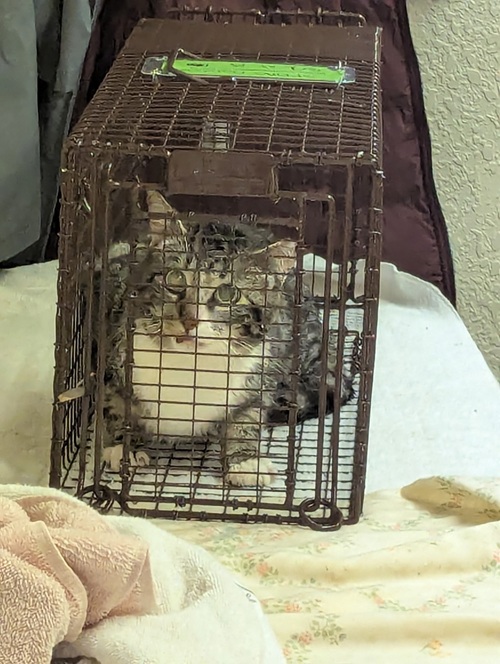
Chester, CA 3-5-26 – The sixth Spayathon will be held March 14 at Indian Creek Veterinary Center in Crescent Mills, continuing a proven program to address the growing feral cat population in Plumas County. Thanks to the commitment of local partners and volunteers, the program has already spayed and neutered 377 cats, making progress in reducing the overpopulation and improving community health.
The growing feral and community cat population became increasingly apparent in the aftermath of the 2021 Dixie Fire, which served as the catalyst for launching a local solution. Cats displaced by residents who lost their homes, along with feral cats that survived the fire, remained in the Greenville area. Compassionate community members stepped in to feed and care for them, ensuring their survival.
Without available funding for spay and neuter services and in the absence of an established Trap-Neuter-Return (TNR) program, the population expanded and soon reached unmanageable levels. Local rescue organizations, including Plumas Animal Welfare Society (PAWS) and Friends of Plumas County Animals, became overwhelmed by the increasing number of cats in need.
Recognizing that long-term population control required a coordinated and sustainable approach, these organizations worked to establish a formal TNR program. Through dedicated volunteers, veterinary partnerships, and community support, the program has since evolved into the structured initiative it is today.
The Almanor Foundation (TAF) is proud to support this program with a $2,000 grant as part of the Wildfire Recovery to help sustain and expand its impact. “TAF has supported the effort to reduce the population of feral cats with grants since the first Spayathon in 2023. We are most appreciative of the dedicated work of this amazing team of volunteers as they continue to make a difference in the lives of the cats and their communities,” says Susan Bryner, CEO of TAF.
This effort is made possible by dedicated veterinarians and their assistants who generously donate their time and expertise, along with more than 25 volunteers from Friends of Plumas County Animals, PAWs, and Plumas County. Together, they are working toward a humane and sustainable solution to decrease the feral cat population. Donations go to buying the traps, food for the cats, and surgical/recovery supplies.
“We do this for the health, safety, and well-being of the cats,” said Rose Buzzetta, Executive Director of Friends of Plumas County Animals. “By spaying and neutering, we also make a positive impact on the environment and the economic vitality of our communities. No one wants to purchase a home or property where dozens of unmanaged cats are living nearby. Once cats have recovered from surgery, they are released back into the location where they were originally trapped. Buzzetta explains that this process is essential to reducing feral cat populations. “Cats are territorial and typically do not allow other strays to enter their established area. Spaying or neutering cats helps prevent new cats from moving in, and over time, the existing population naturally declines, reducing the number of feral cats in the area,” Buzzetta adds.
With continued community support, the Spayathon remains a practical, compassionate approach to improving the quality of life for both animals and residents throughout Plumas County.
For more information on the Spayathon, please contact Rose Buzzetta, Quincy 530.927.8057; Barbara Montandon, Chester 530.258.1556; Kim or Mary, Greenville 530.566.5591.
Submitted by Katherine Sansone, The Almanor Foundation