
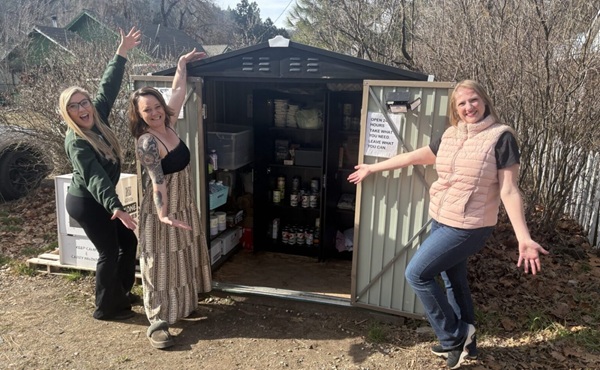
On Nov. 24, the Monday before Thanksgiving, the East Side Pantry officially opened its doors to the public. The small storage shed located at 65 Fairground Road across the street from Pioneer Park in East Quincy is unassuming from the outside, but is playing a vital role in the fight against food insecurity in Plumas County.
The East Side Pantry is a free “take what you need, leave what you can” community food pantry. Inspired by the Little Free Library concept, the Little Free Pantry movement is a grassroots, crowd-sourced response to poverty and food insecurity within neighborhoods across the United States. Mini-pantries provide easy and anonymous access to help eliminate barriers. The model relies on a reciprocal cycle of community support.
Since the East Side Pantry opened, it has seen a steady stream of visitors, according to organizers Danielle Blust, Kristy Tucker and Shelby Janea. Because it is not staffed and is available 24/7, they don’t have an exact count on the numbers, but they report that many community members have expressed their appreciation openly. The community has also stepped up to support the pantry and keep it well stocked. Both individuals and businesses have contributed almost constantly, leaving everything from canned goods and infant formula, to snack items and survival blankets on the shelves.
A grassroots response to food insecurity
The story of East Side Pantry’s creation is the story of three local women who saw a painful gap and decided to fill it. Blust, Tucker and Janea started the pantry during a time of fear and uncertainty in the community. It was the fall of 2025. The longest government shutdown in U.S. history brought with it job furloughs, paycheck pauses and a disruption in Supplemental Nutrition Assistance Program (SNAP) benefits.
For residents of Plumas County, these disruptions raised very real concerns. According to Feeding America, Plumas County has a food insecurity rate of 13.4%, affecting approximately 2,500 residents. The USDA defines food insecurity as limited or uncertain access to adequate food due to lack of money or resources. Plumas County’s rate is higher than both the California state average of 10.2%, and the national average of 10.9%, making our local community particularly vulnerable to even minor halts in food assistance.
For the East Side Pantry Girls, as the trio of Blust, Tucker and Jenea call themselves, this vulnerability was a call to action. All three women have a deep connection to this project.
Quincy native Blust has been coordinating with the Plumas County Public Health Agency since she did her Quincy Junior-Senior High School Senior Project on alcohol and drug prevention in 2015. She now works with the agency in a professional capacity, providing those in active addiction and recovery with resources, education and support. Through her work, she is intimately aware of the challenges and difficulties inherent in accessing stability in our small rural community.
Blust has also experienced the stigma and shame that can come with food insecurity. “I remember being a young single mom in my early 20s, struggling to feed myself and feeling discouraged from using additional resources because of the fear of judgment and disappointment from others in the community,” Blust said. “Later, while working with lower-income community members during a time when EBT [SNAP] access was being threatened, I wanted to make sure everyone could access food without fear of judgment or shame.”
Tucker, a Certified Nursing Assistant and health education specialist at the public health agency, feels the same. “I’ve lived in Quincy for more than 30 years. My three children were born and raised here, and this community has shaped every part of who I am.”