
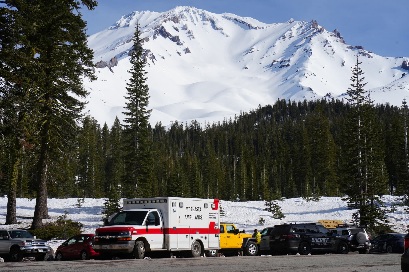
– Mount Shasta Search and Rescue Operation 3/9/2026 –
At 8:22 pm on Sunday, March 8th, the Siskiyou County Sheriff’s Office received a call for help from two climbers stranded in Avalanche Gulch on Mount Shasta. The two climbers, aged 19 and 20 years old from the Bay Area, had successfully summited the mountain Sunday afternoon, but on the descent, one of the climbers lost his footing below Red Banks, and slid approximately 700 feet. In the fall, the climber sustained significant injuries to his shoulder, hand, and ankle and was unable to descend the mountain further.
While an initial rescue effort was initiated Sunday night to retrieve the climbers, high winds and hazardous conditions delayed operations until daybreak. Climbing rangers from the US Forest Service and the Siskiyou County Sheriff Search and Rescue team ascended the mountain and were able to successfully retrieve the duo. The injured climber was then transported to Mercy Medical Center in Mount Shasta to receive treatment.
This incident was the first major Search and Rescue incident on Mount Shasta of 2026, and contains several important lessons for those preparing to climb Mount Shasta this year. First, don’t climb (or ski) late. The Mount Shasta Avalanche Center & Home of the Climbing Rangers advise everyone to begin their descent no later than noon, regardless of skill level. Those who stay on the mountain in the late afternoon, not only risk icier conditions, they also give rescuers more daylight in which to conduct a rescue should anything go wrong. In this most recent incident, the two climbers failed to contact rescue personnel until well after dark when conditions had deteriorated, and had to instead spend the night on the mountain.
Second, ask the local rangers or guides about current climbing conditions before your trip. Though it may appear that climbing season has arrived, ther persistent cold weather and high winds mean that the snow does not soften throughout the day, and climbers will encounter slide-for-life conditions.
Third, if you are planning to climb Mount Shasta or similar high consequence terrain this season, bring crampons, helmets, and ice axes, and learn how to self-arrest. Without these tool and skills, the smallest misstep can turn fatal. Your first summit attempt should not be the first time you use this critical equipment.
Last, always be prepared to self rescue. Even if you are only planning for a day trip, bring the basics, such as an insulated jacket, a bivvy or emergency blanket, a first aid kit, extra food, and water. It is important to understand that rescue operations even under the best conditions take hours, so do all that you can to get yourself to a safe place that easily accessible to rescuers. The easier you are to retrieve, the quicker we can get you to safety.
The Siskiyou County Sheriff’s Office would like to thank the USFS Climbing Rangers, CHP Air Operations, CalOES, and our Search and Rescue volunteers for their tremendous effort to get the climbers to safety. We encourage everyone who plans to recreate on or around Mount Shasta to visit the Mount Shasta Avalanche Center website for the latest climbing and avalanche advisories prior to their trip: https://www.shastaavalanche.org/#/.