
Ashpan pack (eastern Shasta County)
• Status: The pack is active.
• Fieldwork: The area continues to be monitored, with camera trap deployments and ground surveys.
• Collared wolves: None
• Depredation Events: There were two confirmed depredations during the reporting period.
Beyem Seyo pack (eastern Sierra and southern Plumas County)
• Status: The pack is not active. Three adult wolves and one juvenile were lethally removed as a
management action in October 2025. Up to three juvenile wolves remained in the Sierra Valley area at the end of the reporting period. Remains of two juveniles (BEY15M and BEY17M) were discovered and identified via genetics in September.
• Fieldwork: This pack was the main focus of the Strike Team. From July through September, California Department of Fish and Wildlife (CDFW) staff worked round the clock in Sierra Valley to protect livestock and mitigate wolf conflict. Additionally, United States Department of Agriculture (USDA) Wildlife Services led an effort to deter livestock conflict using drone-based hazing in September. Diversionary feeding was utilized as an additional non-lethal management tool on this pack, whereby CDFW attempted to provide alternative food sources to the pack while aggressive non-lethal hazing was implemented. In September, efforts began to capture the pack’s remaining juveniles. During these extensive field efforts, the remains of two pups of the year (BEY15M and BEY17M) were discovered and the cause of their death was undetermined. Lethal control of the pack was also implemented, with LAS23F (breeding female), WHA08M (breeding male, 2021 Whaleback litter), and BEY01F (female, 2023 litter) removed. A single juvenile (BEY12M) was also unintentionally lethally removed by CDFW during this operation. See CDFW press release from 24 October for additional information. Efforts are ongoing to capture the remaining Beyem Seyo juveniles.
• Collared wolves: None
• Depredation Events: There were 41 confirmed and 23 probable livestock depredations during the
reporting period.
Diamond pack (eastern Plumas and southern Lassen County)
• Status: The pack is active.
• Fieldwork: The area continues to be monitored with camera trap deployments and ground surveys.
• Collared wolves: None
• Depredation Events: There was one confirmed livestock depredation during the reporting period. Grizzly pack (southern Plumas County)
• Status: Two adult wolves were detected by camera traps, scat, and visual observation by CDFW
biologists north of Sierra Valley. Genetic analysis of scat samples confirmed an unknown male
(DIS05M) and a female originally from the Lassen pack (LAS37F). Two adult wolves and a pup were also detected northeast of Quincy and are believed to be the same group.
• Fieldwork: Biologists spent 10 days attempting ground captures in this area. CDFW, United States Forest Service (USFS), and private timberland biologists, also deployed cameras, collected genetic samples, and surveyed the area to gather more information on this pack.
• Collared wolves: None
• Depredation Events: There were no depredation investigations during the reporting period.
Harvey pack (southern Lassen and eastern Shasta counties)
• Status: The pack is active.
• Fieldwork: Biologists collected scat at vacated rendezvous sites to confirm the minimum number of pups produced this year. At least 7 pups (4 females, 3 males) were genetically detected.
• Collared wolves: WHA05F (breeding female), HAR04F and HAR05F (both females, 2024 litter),
HAR07M and HAR11M (both males, 2024 litter).
• Depredation Events: There were 22 confirmed and 3 probable livestock depredations during the reporting period. Ice Cave pack (western Lassen, northern Plumas, eastern Shasta, and northern Tehama counties)
• Status: The pack is active. A minimum of six pups were identified through genetic analysis and
camera traps.
• Fieldwork: Biologists collected genetic samples and confirmed the breeding female (WHA09F) and breeding male (ICE03M), six pups (1 female, 5 males), and an additional adult (WHA43M). Biologists captured and collared a pup (ICE04F) during the reporting period, as well as a second pup (ICE08M) who was too small to collar.
• Collared wolves: ICE04F (female, 2025 litter)
• Depredation Events: There were no depredation investigations during the reporting period.
Ishi pack (eastern Tehama County)
• Status: The status of the pack is uncertain. The pack has not been detected since spring, and it is possible that prior detections of wolves in the area were of Ice Cave wolves.
• Fieldwork: The area continues to be monitored with camera trap deployments and ground surveys.
• Collared wolves: None
• Depredation Events: There were no depredation investigations during the reporting period.
Lassen pack (northern Plumas and southern Lassen counties)
• Status: The pack is active.
• Fieldwork: Biologists confirmed a minimum of two pups during unsuccessful capture efforts. The area continues to be monitored with camera trap deployments and ground surveys.
• Collared wolves: None
• Depredation Events: There was one confirmed livestock depredation during the reporting period. Tunnison pack (central Lassen County)
• Status: The pack is active.
• Fieldwork: The area continues to be monitored with ground surveys during this reporting period.
• Collared wolves: No active collars. However, LAS32F (adult female, 2022 Lassen litter) has a non
functioning collar.
• Depredation Events: There were no depredation investigations during the reporting period.
Whaleback pack (eastern Siskiyou County)
• Status: The pack is active. Reproduction this year was confirmed with a minimum of ten pups (5
females, 5 males) identified through genetic analysis and camera traps.
• Fieldwork: Biologists collected scat at vacated den sites to confirm the minimum number of pups.
• Collared wolves: OR85 (breeding male), WHA01F (breeding female), and WHA29F (female, 2024
litter).
• Depredation Events: There were 8 confirmed and 5 probable livestock depredations during the
reporting period. Yowlumni pack (Central Tulare County)
• Status: The pack is active. The remains of YOW1F (the breeding female) were discovered by
biologists. She is thought to have died of natural causes.
• Fieldwork: The area continues to be monitored with camera traps, ground surveys, and genetics collection during this reporting period.
• Collared wolves: BEY03F (adult female, 2023 Beyem Seyo litter).
Depredation Events:
There were no depredation investigations during the reporting period.
Areas of Wolf Activity Southwestern Modoc County – Two wolves were detected by camera traps, scat, and tracks by CDFW biologists during the reporting period. An unknown male wolf (DIS07M) was confirmed through genetic analysis and is consistent with being a sibling to DIS06M. There was one confirmed livestock depredation during the reporting period.
Eastern Sierra County – Three wolves were detected at a livestock depredation investigation during the reporting period. A female wolf (BEY08F – dispersed from Beyem Seyo pack in early 2025) was confirmed through genetic analysis. Incomplete genetic results also indicated at least one male wolf and one wolf originally from the Whaleback pack. This event was the only confirmed livestock depredation event during the reporting period. Dispersing wolves
An unknown number of uncollared dispersers likely exist in the state at any time. CDFW has regularly detected dispersing wolves in California since December 2011. More information is available on the CDFW Gray Wolf webpage in a document called “California’s Known Wolves – Past and Present.”
CDFW continues to receive and investigate reports of wolf presence from across California. Public reports are an important monitoring tool. Please report wolf sightings through the CDFW Gray Wolf web page:
www.wildlife.ca.gov/Conservation/Mammals/Gray-Wolf/Sighting-Report.
Survey for presence (areas of suspected wolf presence)
CDFW continues to survey for the presence of wolves, based on sighting reports and other signs indicating
wolf activity (e.g., suspected wolf depredation, DNA, camera-trap images, tracks). Survey areas include
the “Areas of Wolf Activity” in Plumas and Modoc counties and several additional areas of suspected wolf
presence in Butte, Kern, Modoc, Plumas, and Shasta counties.
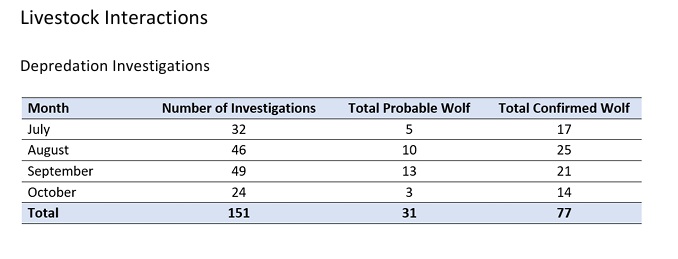
Livestock Interactions
Depredation Investigations
Communication
CDFW staff are in regular communication and coordination with livestock producers, county agriculture
departments, private timberland managers, USDA-Wildlife Services, U.S. Fish and Wildlife, U.S. Forest
Service, conservation organizations, and the public where known wolf activities occur. Ongoing
communications also occur in counties with known wolf activity. During these efforts, CDFW includes
direct information sharing with county Boards of Supervisors, agricultural commissioners, farm service
advisors, members of the local Cattlemen’s Association, and Farm Bureau boards.
Agency and community engagement events:
• July 10 – Tulare County Cattlemen’s meeting – Woodlake, CA
• July 22 – Presentation on wolf-livestock deterrent methods with NRCS – Virtual
• August 13 – Presentation on wolf-livestock conflict to USDA Wildlife Services – Eagle Lake, CA
• August 14 – Interagency Wolf Meeting (CDFW, United States Fish and Wildlife Service, and USDA) –
Virtual
• September 14 – Quarterly check-in with USFS Region 5 – Virtual
• September 24 – Presentation to Trinity County at Science on Tap on wolf ecology, wolf-livestock
conflict, and management – Weaverville, CA