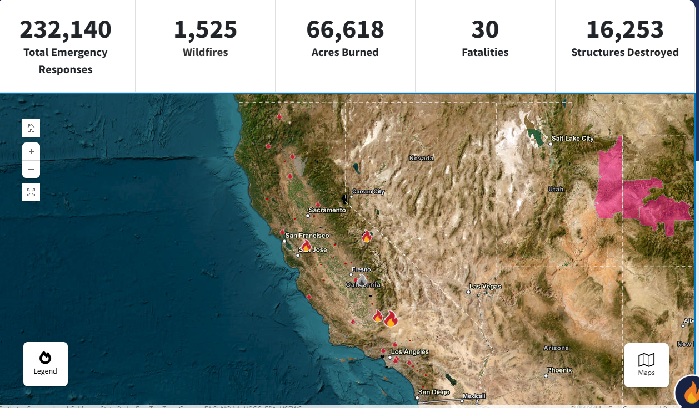
The fire outlook for California from April through July 2025 highlights differing regional risks as the state transitions toward fire season.
In Northern California, significant precipitation in March and lingering snowpack at mid to upper elevations will continue to act as barriers to fire spread through May. However, weather patterns are expected to shift toward warmer and drier conditions from May into July, increasing the flammability of lowland areas… particularly oak-woodlands away from marine layer influence. Despite this shift, significant fire potential remains normal for now, aligning with historical patterns during spring months.
Southern California, on the other hand, continues to experience severe to exceptional drought, especially across the South Coast and Colorado Desert. While the region initially saw limited grass and fine fuel growth earlier in the season, late-season rains have since promoted herbaceous growth. These fine fuels will become increasingly flammable once cured, adding to the risk of large fires..,. especially in timber-dominated mountainous areas where precipitation has remained below average since October 2024.
The likelihood of above-normal significant fire potential is projected to increase in Southern California from late spring into summer. A transition from La Niña to neutral conditions is expected during this time, which may reduce predictability in fire weather but could strengthen coastal marine layer effects in some areas.
Overall, Northern California maintains normal fire potential through May, while Southern California (particularly the South Coast) faces a growing threat of large fires due to persistent drought and increasingly flammable fuels.